The Missing Layer Between Cloud Architecture and Audit Evidence
In this article

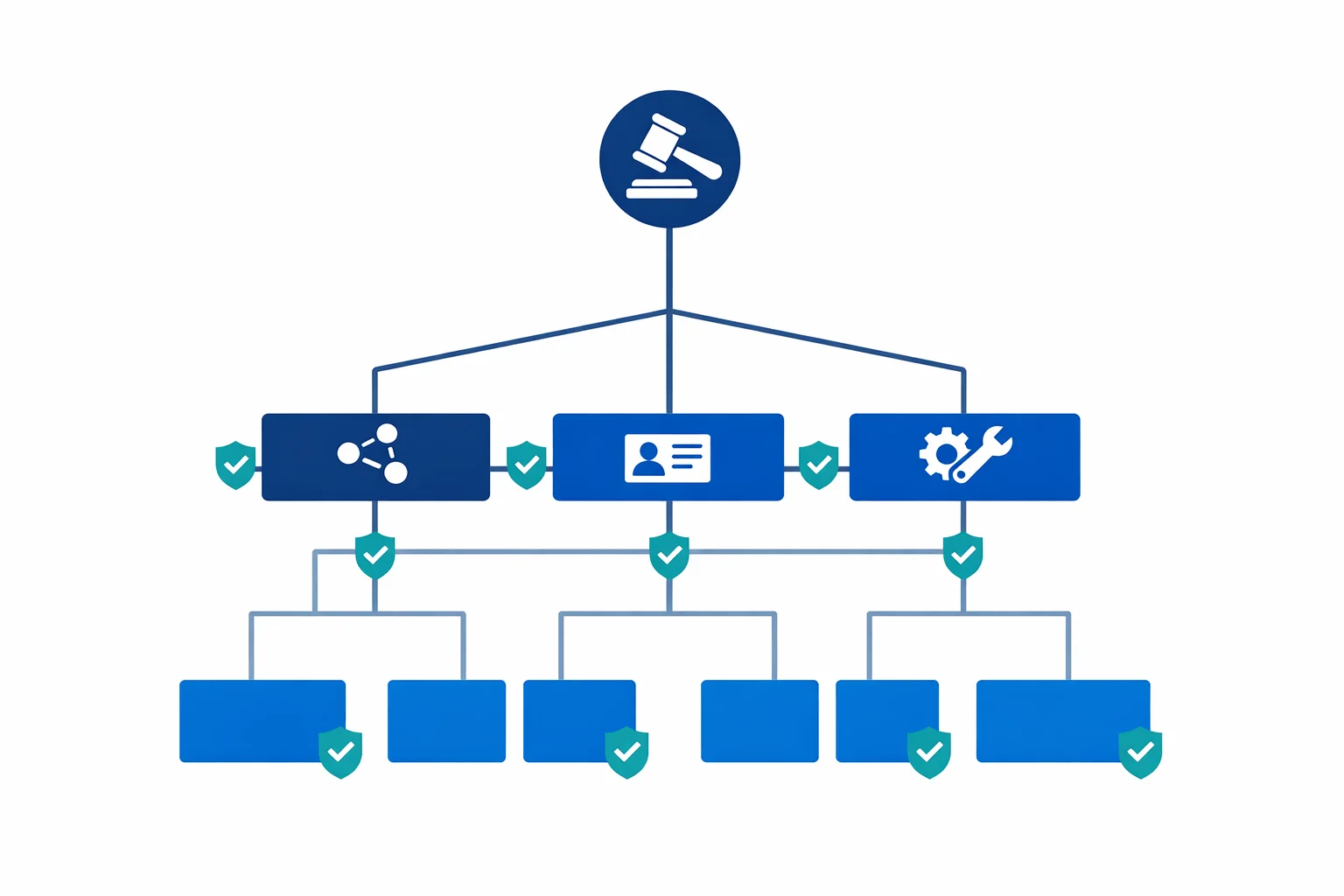
In short: A landing zone can pass a technical review and still collapse the first time someone asks “show me.” Most enterprises already have the controls, the policies, and the dashboards. What they cannot reconstruct on demand is why each control exists, who owns it, which risk it answers, and what proves it still works. That traceability is a design problem, and it belongs in the architecture rather than bolted on the week before an audit.
Most cloud architecture reviews stop at the layer you can screenshot. Subscriptions and management groups, the hub-and-spoke network, identity and Conditional Access, Azure Policy, Defender for Cloud, central logging, the deployment pipelines. All of it matters, and most of it can be assessed in an afternoon. None of it answers the question a regulator, a customer’s security team, or an incoming CISO eventually asks: show me why this is built the way it is, and prove it still holds.
That question lands on a different layer, and in most environments it is the thin one.
A Platform Can Be Correct and Undefendable
We review environments that are, on the engineering merits, fine. The network is segmented. Policies are assigned. Logs land in a workspace with sensible retention. Then we ask who reads the Defender recommendations each week, and the room goes quiet. Or we ask why the payments workload sits in that spoke and not the one beside it, and the honest answer is that the person who decided left in 2024.
The platform is real. The reasoning behind it is gone. An engineer reads that as a documentation gap. An auditor reads it as a set of controls nobody can stand behind, which is the harder problem, because the fix is not technical.
It repeats, with small variations. Central logging exists, but no one is named to act on what it surfaces. Azure Policy runs in Audit mode, quietly accumulating two hundred non-compliant resources that nobody triages because triage was never anyone’s job. Network boundaries are drawn without a written reason. Defender for Cloud carries a secure score and a long list of recommendations, and there is no path that turns a recommendation into either a fix or a recorded decision to accept the risk.
What Turns a Setting Into a Control
A control becomes defensible when you can walk it backward to a reason and forward to a proof.
Take a tightened access requirement on a finance system. The technical output is a Conditional Access policy and a PIM workflow for the privileged roles. That is the easy 20 percent. The part that holds up later is the rest: a named owner, a review cadence, a defined route for exceptions when someone genuinely needs standing access, and a record that the thing has actually been operating rather than configured once and forgotten.
Link those together and you have a control. Skip the back half and you have a setting that happens to be switched on. The difference is invisible in the portal and obvious the moment anyone asks about it.
Where Platform Teams Lose the Thread
The shortage is almost never tooling. By the time we arrive, most enterprises own more dashboards, exports, and alerting than anyone reads. The weak points are structural.
Controls drift away from the risks they were meant to cover, so the line between “we did this” and “because of that” never gets written down. Technical findings float without an owner. Exceptions get granted in a meeting and never recorded, which leaves the next reviewer unable to tell an approved risk from an oversight. Dashboards get treated as the status of the day instead of something you can point back to in six months. And the architecture decisions themselves tend to leave with the project team, which is why audit preparation so often turns into a small archaeology project on your own platform.
Where the Tools Stop
Azure Policy, Defender for Cloud, Sentinel, your tagging standard, the network rules, the pipeline gates. All useful, none self-explaining. A secure score of 72 is not a position you can defend; it is a number waiting for an owner to say which open items are accepted, which are queued, and why. The tools produce raw material. Someone still has to shape it into something a person can stand behind in a review, and that shaping is an architecture responsibility, not a chore handed to the GRC team three weeks before the auditor arrives.
Designing for the Question You Get Later
A mature platform does not document everything to the same depth. That way lies a binder nobody updates. It documents the controls that carry the most risk, and for each of those it can answer a short, blunt set of questions without a scramble: why does this exist, which workload or risk does it protect, who owns it, how would we notice if it stopped working, what happens when we approve an exception, and what could we actually put in front of someone this week.
None of that is paperwork for its own sake. The point is to never have to rediscover your own platform under deadline.
NIS2, DORA, and the Same Question in a Suit
Regulation is converging on the same demand from a different direction. NIS2, DORA, the sovereignty conversations European boards are now having, a customer’s third-party risk questionnaire, the outsourcing and technology-risk reviews a Singapore regulator like MAS runs on the same instincts. Strip the specifics and each one asks whether you can defend the way your platform is run. A diagram will not carry that, and a screenshot of a green dashboard carries it even less. What holds up is a platform whose architecture, ownership, controls, and exceptions line up, and can be shown to line up.
We have written about the pieces of this elsewhere: classifying workloads for sovereignty, keeping NIS2 and DORA hubs separate in the landing zone, and what Belgian NIS2 expects once the basics are in place. This is the layer that ties them together.
Architecture That Survives Its Own Handover
The job does not end at a correct design. It ends, if it ends anywhere, at a platform the people who inherit it can explain, operate, defend, and adjust after the architects have moved on. That shifts the central question of a review. “Is this technically right” stays necessary and stops being sufficient. The one that decides more is whether the decision still stands up six months out, defended by the people who run it, pay for it, and carry the risk when something breaks.
Answer that in the design phase and most of audit readiness comes for free. Leave it for later and you end up reconstructing your own platform in a conference room, under questions, with the clock running.
Related reading: What an Azure Landing Zone Audit Actually Finds · Defender for Cloud in 2026 and What to Enable, Tune, and Skip · Your Board Is Asking About NIS2 · Controlling Sentinel Ingestion Costs · Why Every Azure Enterprise Needs a WAF Analysis Methodology
Looking for Azure architecture guidance?
We design and build Azure foundations that scale - landing zones, networking, identity, and governance tailored to your organisation.
More from the blog
Governator Has Grown Beyond Compliance, and the Data Model Is Why

Azure OpenAI to Microsoft Foundry: When to Upgrade and What to Fix First